

Published in the EU’s Official Journal on December 16, 2022, then transposed into French law on December 6, 2023, the European Sustainability Reporting Directive ( CSRD) consolidates, strengthens and harmonizes non-financial reporting by means of 12European Sustainability Reporting Standards ( ESRS) drawn up by theEuropean Financial Reporting Advisory Group(EFRAG). From 2025 onwards, and according to a progressive application schedule, some 50,000 companies in the EU will publish an annual extra-financial report on their CSR impacts, risks and opportunities, based on the principle of double materiality: impacts of the environment on the company(outside in), impacts of the company on its environment(inside out). This report must be verified by an accredited external body, such as a statutory auditor, chartered accountant, lawyer or certifying body.

| CSRD directive comes into force | First reporting | Companies concerned |
|---|---|---|
| January1, 2024 | 2025 (for the year 2024) | Companies already subject to the directive on the publication of non-financial information in force since 2018. That is, companies meeting two of the following criteria: more than 500 employees, more than €50 million in sales, more than €25 million in balance sheet total. |
| January1, 2025 | 2026 (for the year 2025) | Companies meeting two of the following criteria: more than 250 employees, more than €50 million in sales, more than €25 million in total assets. |
| January1, 2026 | 2027 (for the year 2026) | Listed SMEs (except micro-enterprises: companies with fewer than 10 employees and total assets not exceeding €450,000 or net sales not exceeding €900,000). |
Until now, the exercise requiring companies to report on the extra-financial sphere was framed by the 2014 NFRD directive (Non Financial Reporting Directive, or DPEF in French for “déclaration de performance extra-financière”). But it left companies free to choose the indicators on which they wanted to present data. Advantages of this new framework with standardized indicators:
- year-on-year comparability
- company-to-company comparability
- sector-to-sector comparability
- incentives for continuous improvement
- a vision that is both retroactive and current, as well as forward-looking
- giving credibility to information and combating greenwashing
Sustainability reporting: how to turn it into a genuine corporate project?

The sustainability report is based on reliable and robust ESG data. The quality of this data over time is therefore of paramount importance. The definition, production and collection of data are cross-functional, involving numerous stakeholders both inside and outside the organization. The support and understanding of the employees and stakeholders most concerned are therefore a must! Building a sustainability report is a real corporate project. Setting up a dedicated governance structure, supported by the executive committee, with pilots for each department, makes the exercise federative and meaningful. Training in CSRD issues strengthens the leadership of executive committees and boards of directors, while training members of the steering committee makes them ready to deliver the sustainability report, either independently or with external support.
Sustainability report: how to produce it?
From stakeholder mapping to double materiality analysis
The sustainability report requires an exhaustive, methodological and documented preliminary work (ESRS 2), which will be integrated into the final deliverable. The purpose of this stage is to assess which sustainability themes are important and relevant, and to define, collectively, which of these are priorities. These are :
- Describe the business model
- Modeling the value chain and sphere of influence
- Mapping the company’s stakeholders
- Identify and consolidate a list of potential ESG and financial impacts
- Rating ESG and financial impacts
- Restoring the double materiality matrix
- Explain the analysis carried out and its results (this is the explanatory work required by ESRS 2)
It is the continuousgap analysis between the material indicators you already have and the indicators required by the CSRD that will make it possible to measure how far you still have to go to comply with the CSRD obligations.
Meet ESRS E, ESRS S and ESRS G standards
The voluntary ISO 26000 standard is the international benchmark for CSR and has many links with the ESRS standards of the CSRD directive. It proposes a CSR reading grid based on seven central questions (known as “pillars”), and forms an important basis for understanding the different ESRSs. The table below summarizes these thematic links.
| Theme | ESRS standards |
|---|---|
Governance |
ESRS 2 General information |
Human rights |
ESRS S1 Company's own workforce |
Relationships and working conditions |
ESRS S1 Own workforce |
Environment |
ESRS E1 Climate |
| Fair practices | ESRS S2 Value chain workers |
Consumer issues |
ESRS S4 End users and consumers |
Communities and local development |
ESRS S3 Affected communities |
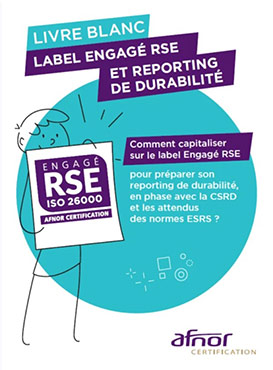
Companies holding a label based on ISO 26000, such as AFNOR Certification’s Engagé RSE label , find themselves at an advantage in understanding CSRD, demonstrating their CSR performance and collecting their sustainability data. An AFNOR Certification white paper, which can be downloaded free of charge here , explains these bridges.
Sustainability report: go it alone or get help?
Depending on the size of your organization and its maturity with regard to CSR issues, you can choose to produce your sustainability report independently or with the help of a consultant.
If you choose not to call on support services, it is advisable to take part in training courses. AFNOR Compétences offers training in CSRD and the challenges of extra-financial reporting adapted to your organization, while AFNOR Editions has set up interactive courses , which enable you to quickly grasp the subject through digital content and concrete examples of application.

If you choose to be accompanied by an expert from outside your organization, what can you expect?
- Methodology and collective intelligence! The consultant specializing in your business sector leads group workshops at every stage of the report’s construction. The objectives are to share, exchange and co-produce, to identify and promote best practices, to identify relevant documented information and to implement the necessary actions, in order to support the company’s strategy and optimize the reporting exercise.
- Coordination and ongoing dialogue! Discusses the expected results of the CSRD approach with the CSRD project team, in order to validate the links established between improved CSR performance and the organization’s financial, commercial, operational and innovation strategies. He/she establishes ongoing communication to ensure that the course is maintained.
- Deliverables! Depending on the scope, he can provide you with the content of your sustainability report, or with preliminary elements such as a double materiality analysis, or various maps (stakeholders, risks, etc.).
If you’d like to call on the services of a consultant, AFNOR Compétences can offer you a tailor-made assignment. If you prefer to call on a team reinforcement and integrate this person into your workforce without managing the administrative and salary aspects, AFNOR Bouche à Oreille can offer you the right profile .
Sustainability report: have it verified by an independent third-party organization

In France, the CSRD regulatory framework stipulates that companies subject to CSRD must have their sustainability report audited by an independent third party chosen from among several corporations: a statutory auditor, a chartered accountant, a certification body or a lawyer. The auditing of the financial report and the auditing of the sustainability report can be carried out by a single third party, or by several third parties (co-insurance principle). Whichever is chosen, the auditor must have completed a mandatory 90-hour training course approved by the French audit authority (H2A) to become a sustainability auditor.
Why choose a certification body?
- Certification bodies are experts in management systems. From strategy to implementation in the field, they have an integrated understanding of the role of management and operational departments, and of their interactions. This global vision makes it easier to assess the extra-financial quality of ESRS responses in the sustainability report.
- Certification bodies have first-hand knowledge of CSR and know how to assess ESG data in concrete terms. This is particularly true when it comes to the QSE (quality, safety and environment) perimeter : mastery of the voluntary standards ISO 9001 (quality), ISO 14001 (environment), ISO 45001 (occupational health and safety) is therefore a plus.
- Certification bodies specialize in specific sectors. The challenges of materiality are not the same in the automotive or bancassurance sectors. Because of their historical role as third-party auditors in the nuclear, agri-food, ESSMS, responsible finance and other sectors, certification bodies have a panel of certifiers specialized by sector of activity.
How is the sustainability report verified?
1
Pre-commitment
Analysis of customer needs and familiarization with the company
2
Commitment and planning
Sizing, signing the engagement letter, building the verification plan
3
Carrying out the mission
Review of reporting processes, on-site and remote checks
4
Finalization
Review of work and issuance of limited assurance opinion
Become a sustainability auditor
Society is waiting for them. Their mission is great, and so is their responsibility! By verifying sustainability reports, sustainability auditors will lend credibility and confidence to extra-financial data, and ultimately to organizations’ transition plans. Would you like to become a sustainability auditor? AFNOR Compétences and Apave have jointly designed a 90-hour module , approved since April 23, 2024 by the Haute autorité de l’audit (H2A, formerly H3C). Completing a certified training course is a prerequisite for registering as a sustainability auditor with the H2A and practicing this new profession, at the crossroads of CSR assessment and the world of numbers.
Guidelines
The High Authority for Auditing has published guidelines for the certification of sustainability and taxonomy information under Article 8 of Regulation (EU) 2020/852. These guide auditors in carrying out their mission. Consult this directive here, as of October 2, 2024

Discover 100 CSR and sustainable development questions, by Alain Jounot