
In the role of guiding and coordinating the French standardization system entrusted to it by the decree of June 16, 2009, amended by decree no. 2021-1473 of November 10, 2021, AFNOR acts as the central coordinator of standardization in France, identifying standardization needs and mobilizing interested parties. Strategic committees (COS) organized by market or theme ensure the collective management of standardization programs.
Identify needs
Each COS brings together the key decision-makers in the economic sector concerned, defines work priorities and prepares France’s French positions on the international stageAFNOR represents France at CEN-Cenelec and ISO-IEC. All this is coordinated by the Comité de Coordination et de Pilotage de la Normalisation (CCPN), responsible for preparing the French standardization strategy, defining the objectives and general priorities of standardization programs, and ensuring their consistency with national, European and international policies.
Coordinating standards development
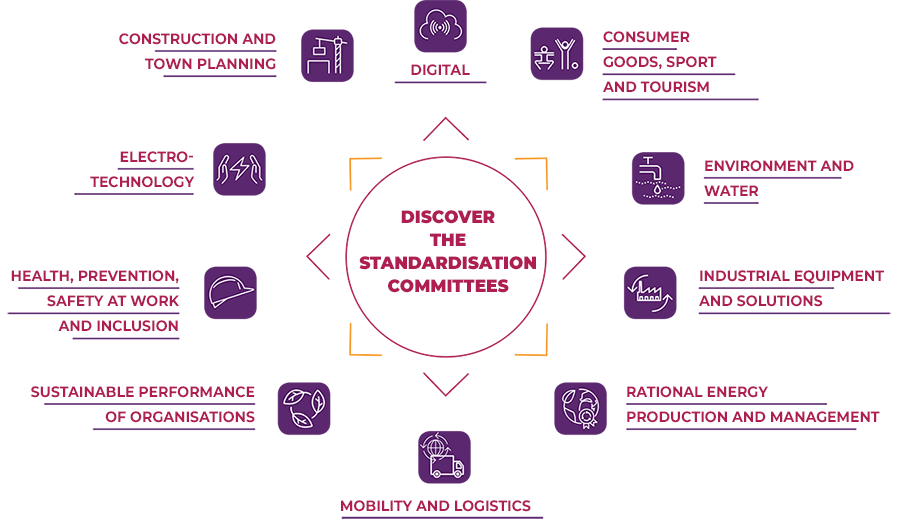
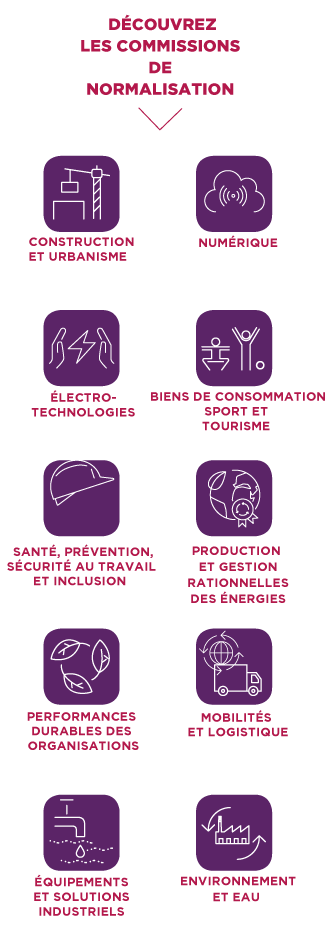
Standards are drawn up by standardization committees and run, by delegation from AFNOR, by sector-specific standardization offices (BNS) or by AFNOR itself in fields common to a large number of sectors and in sectors for which there is no approved BNS (electrotechnologies, agri-food, services, etc.).
Approve and publish standards
AFNOR organizes a public consultation in French on each draft French, European or international standard. Once the comments have been studied and the draft finalized, AFNOR approves the final version and includes it in the national catalog. Their approval as French standards is attested, depending on the level at which they were drawn up, by prefixes such as “NF ISO or NF IEC” (international standard for the general sector or the electrotechnology sector adopted in France), “NF EN ISO or NF EN IEC” (French standard of international origin for the general sector or the electrotechnology sector adopted in Europe and France), “NF EN” (French standard of European origin whatever the sector) or “NF” (purely French standard). AFNOR is responsible for the publication of standards, and constantly ensures that published standards remain relevant.
Promoting French interests at European and international level
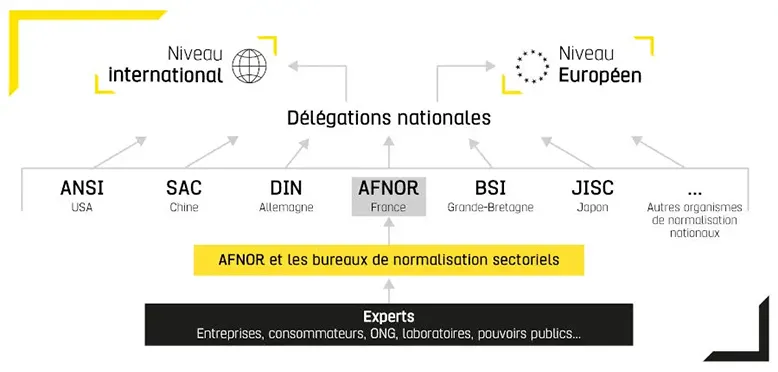
As 90% of voluntary standards are of European or international origin, AFNOR represents French positions at European and international levels. As such, AFNOR is the French member of CEN and ISO, as well as CENELEC and IEC through the French Electrotechnical Committee (CEF), which it hosts. Every year, AFNOR publishes its international barometer, which provides an analysis of the distribution of responsibilities (based on the number of secretariats obtained by each country).
The life cycle of a standard
It takes from a few months to three years to create a standard. Before being certified, the standard is submitted to the public for approval, whether or not they contributed to its drafting. This is the public inquiry stage. Once published, any player may or may not refer to it.
A living, evolving tool, each standard is reviewed and revised, if necessary, every 5 years, with a view to continuous improvement and reflecting best practices in the field.

