

Implementing a CSR approach is a good thing. But if it contributes to the Sustainable Development Goals (SDGs) through concrete actions, all the better!
What are the SDGs?
In 2015,
17 Sustainable Development Goals (SDGs)
were defined and adopted by the UN. These 17 priorities for economic and social development that is more respectful of people and the planet are to be achieved by 2030.
Integrated into
Agenda 2030
the SDGs define the path we must follow to ensure a more sustainable future, leaving no one behind.
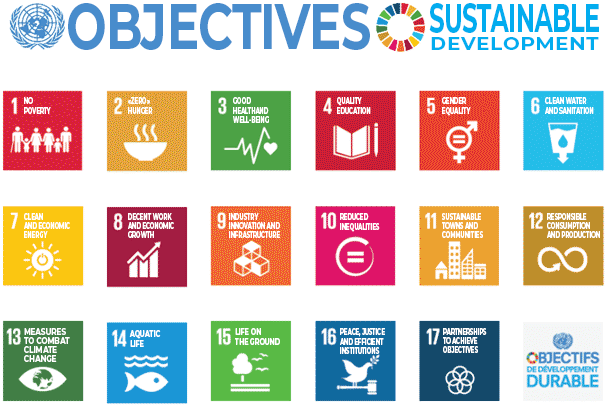
What CSR actions should be taken to achieve the SDGs?
States, citizens, local authorities, businesses, NGOs… The SDGs concern all economic and social bodies. To contribute to this, many companies are integrating sustainable development objectives into their CSR approach. The SDGs become benchmarks for defining and structuring strategy.
The company can take action on :
- Transformation of internal operations: a company that reviews its equal opportunities policy for women and men contributes to the achievement of objective no. 10 “Reduced inequalities”.
- Product or service innovation: by developing new products that consume less energy, or by opting for production methods that emit fewer greenhouse gases, companies contribute to SDG 12 “Sustainable consumption and production”.
- Stakeholder relations: is your company a humanitarian? It can contribute to MDG 8 on decent work by working only with partners and suppliers who respect human rights and safety at work.
Beyond long-term strategies aligned with the SDGs, certain events can reveal emergencies on which we can work reactively.
Take the COVID-19 pandemic: this global economic and social crisis should prompt companies to rethink the way they contribute to sustainable development goals. CSR practices need to adapt: how can we limit current or future impacts on responsible production, sustainable growth, employee health and well-being…? Aligning our CSR actions with the SDGs is more necessary than ever. Aligning our CSR actions with the SDGs is more necessary than ever. Find out for yourself by downloading our white paper ” Label Engagé RSE: how a CSR approach can contribute to the SDGs “.
How do you build a CSR report that contributes to the SDGs?
Non-financial or CSR reporting is a document that structures the CSR approach, presenting the responsible actions taken and the results.
Until 2025 and the entry into force of the CSRD directive (see below), the NFRD directive applies in Europe, and in France through the DPEF (déclaration de performance extra-financière).
It’s all about reporting. The aim is simple: to improve transparency about the company’s activities and practices.
Published periodically (usually every year), it is :
- Mandatory for large companies with over 500 employees and sales of over €40 million for listed companies, or over €100 million for unlisted companies.
- Recommended for all other companies, to highlight their commitments, communicate concrete results and involve all stakeholders.
To build CSR reporting that is compliant and in line with the SDGs, it is essential to rely on benchmark extra-financial tools. These define a framework for assessing the CSR approach implemented, such as the Global Reporting Initiative (GRI) and the voluntary ISO 26000 standard. To find out more about the contribution of voluntary standards to non-financial reporting, watch the replay of our May 20, 2021 web-conference.
From CSR reporting to sustainability reporting
The European Sustainability Reporting Directive (CSRD), adopted on 14 December 2022, will clarify, systematise and standardise non-financial reporting. By 2025, companies with more than 250 employees will be required to produce an annual report outlining the impact of their activities on the environment. ESG sphere (environment, social, governance), based on a double materiality analysis: impact of the environment on the company(outside in), impact of the company on its environment(inside out). This report must be endorsed by an authorized external body, such as a statutory auditor, chartered accountant or third-party organization such as AFNOR Certification.

What’s new is that the information to be produced will have to be based on standardized indicators, those of the ESRS standards : until now, each company could choose and produce its own indicator; from now on, they must all use the same indicators. This opens the door to comparability, from one year to the next, from one company to the next, from one sector to the next. Ultimately, the aim is to change practices. The Engagé RSE label label from AFNOR Certification, whose ISO 26000-inspired reference framework intersects with these standards, is an excellent way to prepare for this exercise.Download our free white paper “Engagé RSE label and sustainabilityreporting “!
The CSRD directive calls for a first report in 2025, based on your 2024 data. Companies, SMEs, auditors, assessors, take advantage of the countdown to training! AFNOR Compétences offers two training modules:

Discover 100 CSR and sustainable development questions, by Alain Jounot